

.svg)
How Much Does Interior
Car Detailing Cost?
$150-$250 is a defensible 2026 planning range — cabin size, soil, stains, odors, and upholstery material move the final number.

Quick answer: A standard interior detail runs about $150-$250 in the 2026 U.S. advertised-price data, with a median near $199. That covers a structured cleaning of the cabin. Pet hair, embedded stains, odor-source work, and delicate materials are priced as add-ons because they change labor far more than a package name suggests.
How much does interior car detailing cost on average?
In the United States, standard interior detailing commonly costs about $150-$250 in 2026, while a light vacuum-and-wipe service may be lower and an intensive restoration can exceed $300-$400. The range is wide because "interior detail" is not a standardized package. A clean sedan that needs routine maintenance is a different job from a three-row SUV with embedded pet hair, spills, smoke residue, or damp carpet.
The most useful current benchmark comes from the TopDetailers U.S. price dataset, which last read advertised prices in August 2026. It places the middle half of interior-detail prices at $150-$250 with a $199 median, based on 927 businesses. Jobber's April 2026 pricing guide gives a broader $100-$300 benchmark for interior detailing and notes that many businesses charge $100-$350 or more depending on size and condition. These are planning figures, not BGI's menu or a guaranteed national tariff.
| Interior service level | Dated U.S. planning range | Typical scope | Important limitation |
|---|---|---|---|
| Light maintenance cleaning | About $50-$100, 2026 industry guides | Vacuum, dust removal, basic wipe-down, interior glass | Usually excludes extraction, deep stains, pet hair, and odor-source treatment |
| Standard interior detail | $150-$250, August 2026 dataset | Thorough vacuuming, crevices, surfaces, mats, glass, and material-appropriate cleaning | Exact inclusions differ by shop |
| Expanded interior detail | Roughly $175-$300+, April 2026 guide | Deeper carpet, upholstery, leather, or trim work | May still price heavy condition issues separately |
| Intensive restoration | Frequently $300-$400+ in 2026 market guides | Severe soil, repeated extraction, extensive pet hair, odor or specialist work | Inspection is essential; some contamination is outside ordinary detailing |
BGI Pro Auto Detailing publishes an inspection-led process: vehicle check-in, interior and exterior cleaning stages, treatment, finishing, and final inspection. For an interior-only job, the quote should identify the vehicle, cabin layout, materials, condition, and requested result. BGI pricing should therefore be treated as inspection- and scope-dependent rather than inferred from a national average.
The shortest correct answer is this: budget around $150-$250 for a normal interior detail, then expect the quote to move with size, soil, materials, and add-ons. Ask for the written scope before comparing prices.
What is included in a standard interior detailing service?
A standard interior detail usually includes systematic vacuuming, removal of loose dust and debris, cleaning of accessible surfaces and crevices, attention to mats and interior glass, and a final material-safe finish. It should go beyond a quick vacuum, but it does not automatically include every form of stain extraction, odor remediation, or restoration.
| Interior area | Standard work commonly included | Work that may be optional or condition-based |
|---|---|---|
| Seats and carpet | Vacuuming, brushing where appropriate, surface cleaning | Hot-water extraction, intensive stain treatment, pet-hair removal, repair |
| Floor mats | Removal, vacuuming, and cleaning appropriate to rubber or textile | Deep extraction, stain restoration, replacement |
| Dashboard and console | Dust removal and material-safe wipe-down | Repair of scratches, peeling coatings, sticky degraded plastics |
| Door panels and pockets | Vacuuming and cleaning of accessible surfaces | Disassembly or repair of damaged trim |
| Crevices and seat tracks | Focused vacuuming, brushes, air tools where safe | Seat removal or work around electrical components |
| Interior glass and mirrors | Streak-controlled cleaning | Film removal that requires specialty treatment |
| Leather, vinyl, and plastic | Cleaner selected for the material; restrained finishing | Conditioning or protection when not included in the package |
| Fabric and headliner | Light surface care after testing | Saturation, aggressive steam, deep headliner treatment, repair |
The process should begin with loose items and debris because grinding particles into upholstery makes later cleaning harder. The technician then works from upper areas toward lower areas, separates tools used on dirty floor zones from those used on touch surfaces, and chooses products according to the manufacturer and material. Screens, piano-black trim, coated leather, fabric, and Alcantara-like surfaces cannot be treated as if they were the same plastic.
Extraction and odor treatment are often separate because they add labor, product, drying, and risk. Extraction introduces moisture into carpet or upholstery; it must be controlled and followed by adequate drying. Odor treatment should target the source rather than cover it with fragrance. If the odor comes from padding, a leak, smoke contamination, mold, or biological material, routine detailing may not be sufficient.
BGI's service page describes vacuuming, wipe-downs, deep cleaning, treatment, and a final quality check, but a customer should still confirm the exact interior-only scope. Ask whether the trunk or cargo area, third row, child-seat zones, seat rails, vents, leather care, extraction, and odor work are included. A clear written answer prevents a "standard" package from becoming an argument at pickup.
How much does interior car detailing cost per hour?
When a shop bills interior detailing by time, a customer-facing 2026 planning rate is roughly $50-$100 per labor hour. Jobber's April 2026 pricing guide reports that range for detailing businesses, while also noting that many providers price by package, vehicle size, or service instead of displaying an hourly rate. The hourly figure is a business charge, not the technician's take-home wage.
That distinction matters. A shop rate must cover labor, payroll costs, chemicals, towels, machines, utilities, insurance, rent, booking and customer service, vehicle movement, quality control, and profit. Mobile providers also carry travel time, fuel, commercial vehicle costs, and setup. The U.S. Bureau of Labor Statistics reported a 2024 mean wage of $17.21 per hour for automotive and watercraft service attendants, but wage data should never be mistaken for the retail labor rate. The customer is purchasing an organized service operation, not only minutes spent holding a vacuum.
Interior labor is difficult to predict from photos alone. A three-hour estimate can change when the technician discovers sand beneath movable mats, pet hair woven into carpet, sticky residue in switches, damp padding, or multiple rows of seat tracks. Conversely, an experienced team with strong tools and a repeatable workflow may finish faster than a lower-priced operator without sacrificing quality. Judging value by the clock can punish efficiency.
Packages are therefore common. A provider estimates typical labor and materials for a defined condition, publishes a starting price, and adds condition charges when inspection reveals more work. This gives the customer a total to approve while protecting the shop from a vehicle that is far beyond the assumed condition. For uncertain restoration work, an hourly block with a cap can be appropriate-for example, "up to three hours, then call for authorization."
When comparing BGI's quote, ask whether it is fixed, "starting at," or subject to a post-inspection adjustment. If an hourly component applies, request the estimated hours, maximum authorized amount, and the tasks covered. A transparent package with a clear result is usually more useful than multiplying an hourly rate without knowing what the technician will accomplish.
How do vehicle size and seating layout affect interior detailing cost?
Vehicle size and seating layout affect cost because cabin area, seat count, cargo volume, and access determine how much cleaning the technician can physically perform. A larger vehicle does not simply consume more chemical. It creates more edges, rails, panels, cupholders, glass, carpet, and awkward working positions.
| Cabin type | Main labor drivers | Likely pricing position | Details to disclose for an accurate quote |
|---|---|---|---|
| Coupe or compact sedan | Small cabin, but rear-seat access may be tight | Lower to middle range if condition is normal | Folding seats, small rear footwells, trunk condition |
| Full-size sedan | More carpet and seat area with generally straightforward access | Middle range | Rear seat, trunk, leather or specialty trim |
| Two-row crossover/SUV | Larger cargo zone, taller cabin, more glass and trim | Above comparable sedan | Cargo use, pets, seat-back condition, roof liner |
| Three-row SUV | Additional seats, tracks, cupholders, vents, and footwells | Higher range | Third-row use, child seats, spills, cargo well |
| Pickup truck | Cabin size varies; work-truck soil can be concentrated | Condition-dependent | Crew cab versus regular cab, work dust, under-seat storage |
| Minivan | Multiple sliding-seat mechanisms, deep floor channels, family-use soil | Often high for full interior work | Seat rails, removable seats, child zones, cargo space |
| Specialty or luxury cabin | Delicate surfaces, complex controls, unusual geometry | Custom quote may be appropriate | Material list, manufacturer restrictions, prior damage |
Third-row vehicles illustrate why capacity matters. The technician may need to fold, slide, and reposition seats to reach rails and transitions. Every cupholder, latch pocket, console, and door card becomes another cleaning zone. Child seats and personal equipment may limit access; shops often ask the owner to remove them because reinstalling safety equipment creates responsibility the detailer should not assume.
Layout can outweigh exterior dimensions. A pickup may be physically large but have a simple regular cab, while a shorter minivan can contain complex tracks and years of family use. Delicate design also slows the process. Perforated leather, contrast stitching, soft-touch coatings, screens, gloss-black trim, open-pore wood, and suede-like materials require lower-risk methods and more testing.
For a BGI estimate, provide the exact model and seating configuration, not just "SUV" or "truck." State whether every row and the cargo area should be included. Remove valuables and photograph the rear seats, floor, and cargo space. A clear layout description lets the shop price real work instead of adding a broad size surcharge after arrival.
How does interior condition change the final price?
Interior condition changes the final price by changing the number of passes, tools, chemicals, drying time, and safety decisions required. Normal dust and light debris fit a standard workflow. Embedded sand, biological contamination, smoke, mold, or years of neglect may require a restoration plan — or a specialist outside ordinary detailing.
Accumulated debris increases vacuum and agitation time, especially when particles have migrated under rails and into carpet edges. Pet hair can hook into textile fibers and resist ordinary vacuuming. Spills may remain on the surface or soak into foam and padding. Smoke residue settles across glass, plastics, fabric, and the ventilation system, so a quick deodorizer cannot solve it. Bodily fluids require disclosure before the appointment because they can present health and contamination risks; a general detailer may decline the work or refer it to a biohazard-remediation provider.
Mold deserves particular caution. Visible growth often indicates a moisture source, and cleaning the visible surface without fixing the leak can allow recurrence. EPA mold-cleanup guidance explains that porous materials can be difficult or impossible to clean completely and may need disposal; contaminated-water or larger mold problems call for experienced professional remediation. Although that guidance is written for buildings, the underlying limitation of porous carpet, padding, and fabric is directly relevant to a vehicle cabin. BGI should assess whether the condition is within detailing scope rather than promise restoration sight unseen.
Neglected surfaces can also be permanently damaged. Dye transfer, abrasion, UV fading, cracked coatings, chemical etching, or delaminating trim will not become new through cleaning. More aggressive chemistry can make the damage worse. A professional estimate should distinguish removable soil from wear or material failure.
For an accurate quote, send wide cabin photos and close-ups, identify the source and age of stains or odors, mention leaks or prior cleaning attempts, and state whether children, pets, smoke, or sensitive occupants are involved. The final price should reflect the approved treatment and its limits. If inspection uncovers a safety or material risk, pausing the job is responsible — not a failure to detail.
Which stains and odors usually require an add-on service?
Stains and odors usually require an add-on when routine surface cleaning cannot reach the residue, when treatment must be matched to a contaminant, or when extra drying and safety controls are needed. Typical examples include old food and beverage spills, pet accidents, smoke residue, vomit, milk, deeply embedded organic matter, and odors linked to moisture or mold.
Extraction is a common upgrade for textile seats and carpet. A cleaning solution is applied in a controlled way, agitated, and recovered with an extractor. The operator must avoid over-wetting and must allow enough drying time. Enzyme-compatible treatment may help with certain organic residues, but the product must suit the material and the source must still be physically removed. Fragrance only masks odor and should not be presented as remediation.
Leather and coated surfaces require a different approach. Conditioning may be appropriate after cleaning when the material and manufacturer guidance support it, but it does not reverse cracking, dye loss, abrasion, or coating failure. Every stain treatment should begin with an inconspicuous spot test. Color transfer, sunscreen, cosmetics, ink, and harsh products can alter a finish permanently, so "complete removal" is not a responsible promise.
Ozone treatment deserves special scrutiny. Some providers use ozone in unoccupied vehicles, but EPA guidance on ozone generators states that ozone can harm lungs, may be ineffective against many contaminants at concentrations within health standards, and can damage materials such as rubber, wire coatings, and fabrics. It may also create irritating reaction by-products. If ozone is proposed, ask who controls the concentration, how the unoccupied vehicle is ventilated, what source cleaning occurs first, and whether the process follows applicable safety guidance. Do not treat ozone as a substitute for removing contaminated material.
The right add-on begins with diagnosis: identify the source, determine whether it is on the surface or below it, choose a compatible method, explain limitations, and confirm drying. If BGI concludes that mold, sewage, bodily fluids, or severe contamination needs a specialist, follow that referral. A safe partial improvement is better than an unsafe guarantee.
Does upholstery material affect the cost of interior detailing?
Yes. Upholstery material affects cost because cloth, coated leather, vinyl, suede-like surfaces, perforated sections, and delicate trim require different chemistry, moisture levels, tools, and test procedures. The most expensive mistake is treating every seat as generic fabric.
Cloth often tolerates controlled extraction, but fiber type, backing, dyes, prior cleaners, and stain age affect the method. Too much moisture can extend drying or carry residue deeper. Leather in modern vehicles is commonly coated, so cleaning should respect the topcoat; aggressive solvents, stiff brushes, or heavy saturation can cause discoloration or wear. Vinyl may look similar to leather but responds differently to conditioners and solvents.
Alcantara and other suede-like materials need particular care. Alcantara's official cleaning guide recommends soft brushing or a dry cloth for routine dust, a slightly damp white cotton cloth for regular cleaning, and avoidance of direct steam, chlorine bleach, aggressive solvents, and excessive heat. A cleaner designed for ordinary carpet or leather can permanently change the nap or color. Manufacturer instructions should take priority over a universal detailing recipe.
Vehicle-specific guidance matters too. Tesla's current cleaning instructions warn that solvents, bleach, citrus, naphtha, and silicone-based additives can damage interior components; they also caution against over-wetting carpet. Other manufacturers publish different restrictions. That is why the technician should identify the material, check the owner's manual when needed, and test in an inconspicuous area.
Material complexity can increase labor even when the cabin looks clean. Perforations, contrast stitching, piping, screens, piano-black panels, matte finishes, and open-pore trim require careful tools and reduced pressure. Ask BGI whether specialty-material treatment is included and disclose aftermarket upholstery or repairs. Paying for the correct method protects the interior; a lower price achieved by using one strong cleaner everywhere is poor value.
Cost can also rise when several materials meet in one small area. A seat may combine coated leather, perforated inserts, fabric piping, plastic controls, and electronic ventilation. The technician must control product migration and moisture around seams and switches, then inspect the finish from several angles. That extra care is legitimate labor even when no dramatic stain is present.
How long does an interior detail take?
A standard professional interior detail commonly takes about 1.5-3 hours, while a large or heavily soiled cabin can take four hours or more. The clock depends on vehicle size, staffing, condition, extraction, pet hair, odor work, and drying. Time bands should be treated as planning estimates, not promises made before inspection.
A 2026 detailing-time guide places interior-only service at roughly 1.5-3 hours and notes that stains, pet hair, and odor treatment extend the appointment. BGI's broader automotive detailing page says most detailing services take 2-5 hours depending on vehicle size and condition. Neither range means every interior can be completed in that window. A maintenance clean may be shorter; a minivan with multiple rows, embedded debris, and extraction can occupy most of a day.
The active labor typically includes inspection, removal of mats, vacuuming, agitation of seams and carpet, cleaning of surfaces, glass, upholstery-specific treatment, final vacuuming, and quality control. Some tasks can overlap when a team works on different zones. Others must remain sequential: loose soil should be removed before wet cleaning, stain products need dwell time, and extraction must be followed by drying and inspection.
Drying is not idle time that can always be eliminated. Upholstery and carpet that remain damp can transfer moisture, hold odor, and make the vehicle uncomfortable to use. Weather, ventilation, material thickness, and how much solution was applied all affect the handoff window. Ask whether the vehicle can be driven immediately, whether mats should remain out, and how long windows or ventilation should be managed after pickup.
Before booking, request a time range after BGI reviews photos or the vehicle. Clarify the latest pickup time and whether same-day use is essential. If the shop discovers more work, it should explain the revised timeline. A realistic schedule protects quality; rushing a deep interior merely to meet an arbitrary hour count can leave residue, dampness, or missed areas.
How should you prepare your car for an interior detailing estimate?
Prepare for an interior detailing estimate by making the cabin easy to inspect and by disclosing the issues that photos cannot communicate. Good preparation is not pre-cleaning the car until the problem disappears. It is removing obstacles and giving the shop accurate information.
Use this short checklist:
Do not hide a severe condition to obtain a lower telephone estimate. If the technician schedules two hours for a job that actually needs five, the result is likely to be a revised quote, delayed pickup, or an incomplete service. Honest photos let BGI prepare tools and allocate enough time.
Preparation also protects ownership boundaries. The shop should not decide what personal property can be discarded, reinstall safety seats without agreement, or assume an unlabeled object is trash. A nearly empty cabin allows the technician to reach surfaces and reduces the risk of lost items.
At check-in, walk around the vehicle and review existing damage, warning lights, seat functions, delicate trim, and the desired outcome. Make sure the final work order lists exclusions and add-ons. This five-minute conversation is often more valuable than searching for the lowest advertised price because it turns a generic package into a service plan for the actual interior.
What is the bottom line on interior detailing cost?
The bottom line is that $150-$250 is a defensible 2026 U.S. planning range for a standard interior detail, but the vehicle-specific price depends on cabin size, layout, soil, stains, odors, materials, and safety considerations. Light maintenance can cost less; intensive restoration or specialist remediation can cost substantially more. BGI should confirm the final scope after reviewing the vehicle.
Use this quote-comparison checklist before authorizing work:
| Compare | What a useful quote should state |
|---|---|
| Vehicle and condition | Exact model, row count, cargo area, visible soil, disclosed odor or contamination |
| Standard scope | Vacuuming, crevices, mats, surfaces, glass, and material-specific cleaning |
| Add-ons | Extraction, pet hair, stain treatment, odor-source work, leather care, specialist services |
| Materials and risk | Product compatibility, spot testing, manufacturer restrictions, existing damage |
| Price method | Fixed package, starting price, condition adjustment, hourly cap, and approval process |
| Time | Drop-off, active work estimate, drying, pickup, and aftercare |
| Result | Areas expected to improve, permanent damage, and work outside detailing scope |
Contact BGI Pro Auto Detailing with photos, the exact vehicle, and the main problem areas. Ask for a vehicle-specific assessment rather than treating a national median as BGI's price. A good estimate makes the scope, limitations, timing, and authorization clear before the cabin is taken apart or wet-cleaned.
Also decide what "finished" means before comparing totals. One quote may cover a maintenance clean of accessible surfaces, while another includes seat removal where appropriate, intensive crevice work, extraction, and odor-source treatment. Ask whether the trunk, third row, child-seat area, headliner, and drying management are included. If the expected outcome is not written, even similar prices may represent very different jobs.
After service, inspect the cabin before leaving. Check glass, seat seams, mats, cargo areas, touch points, and any stain or odor that shaped the estimate. Confirm which areas improved, which permanent damage remains, and how long textiles should dry. This short handoff creates a useful record for maintenance and prevents normal material limitations from being mistaken for missed work.
Car detailing at BGI Pro Auto Detailing in Sacramento
At BGI Pro Auto Detailing, every quote starts with an inspection of your actual vehicle — not a package name. We separate routine cleaning, condition-driven restoration, and long-term protection into clear line items, so you approve the scope in writing before work begins. Our team holds a 4.9-star rating from 380+ Sacramento-area drivers and serves Sacramento, Placer, and El Dorado counties with same-day appointments and free quotes.
- Call: (916) 460-9257
- Book: automotive detailing — send your year, make, model, and photos for a vehicle-specific estimate
Written by BGI Tint • Reviewed by Vadym Bugai, owner & lead installer.
Pricing note — accurate as of 2026: Dollar figures are U.S. market estimates collected from published industry data and vary by vehicle, condition, scope, and location. They are not BGI quotes — confirm your exact price after inspection.
Related guides
- How Much Does Car Detailing Cost? 2026 Pricing Guide
- Paint Correction Cost: 1-Step, 2-Step and Full Correction Pricing
- What Does Car Detailing Include? Full Service Breakdown
- How Long Does Car Detailing Take? Service Timing Guide
Sources
- TopDetailers - 2026 U.S. car detailing cost dataset — topdetailers.com
- Jobber - Auto detailing pricing guide (April 2026) — getjobber.com
- U.S. EPA - Mold cleanup in your home — epa.gov
- U.S. EPA - Ozone generators sold as air cleaners — epa.gov
- Alcantara - Cleaning and maintenance guide — alcantara.com
- Tesla - Owner’s manual cleaning instructions — tesla.com

Security film can delay entry and increase the effort or noise required, but it cannot guarantee that a determined intruder will never create an opening.
A written inspection-based estimate is more reliable than a single advertised average.
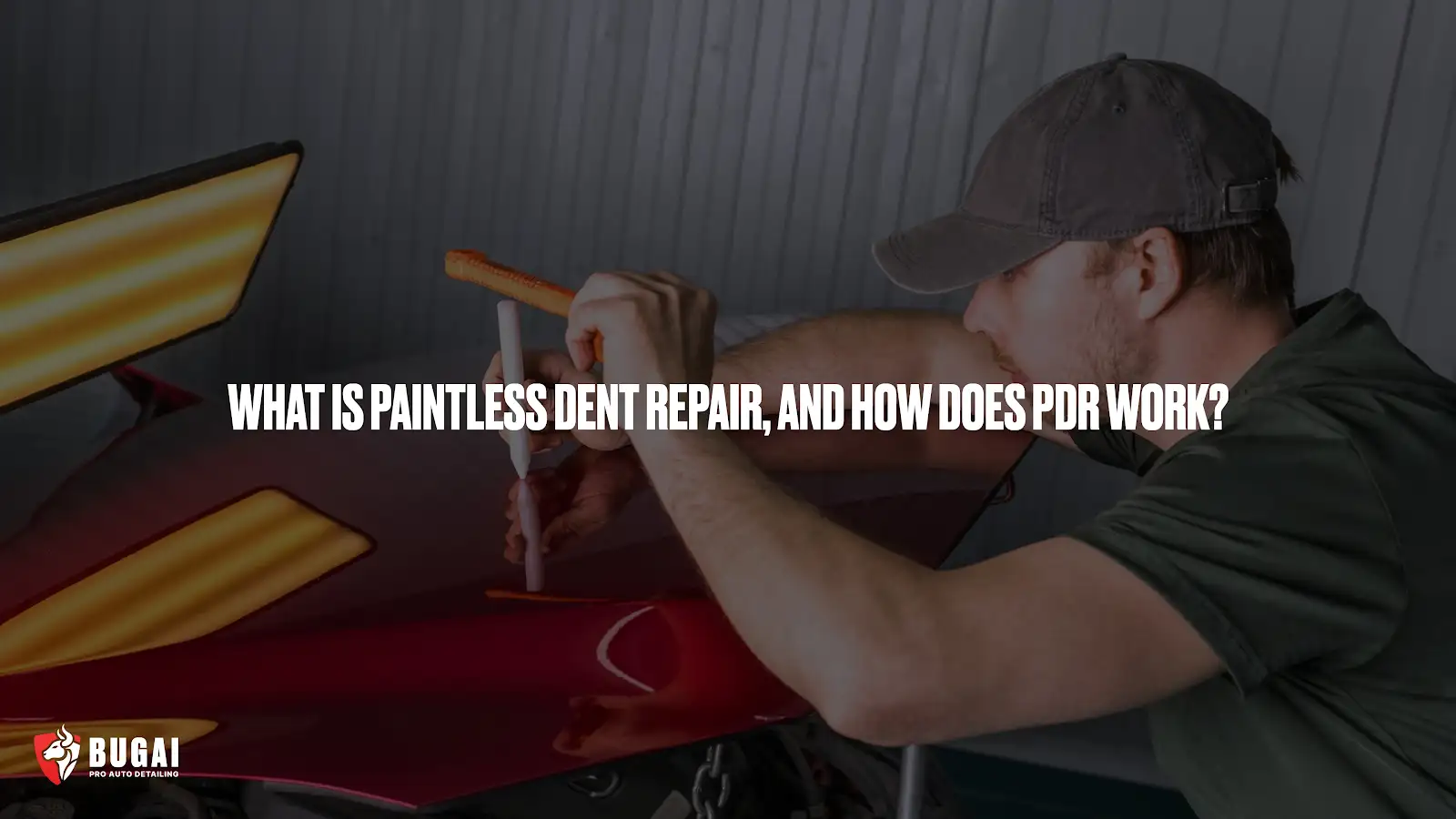
Paintless dent repair, or PDR, is a method of reshaping a dented metal panel without conventional body filler and repainting when the existing finish remains suitable.


