

.svg)
How Much Does Car Detailing
Cost in 2026?
A 2026 U.S. planning range is $125-$260 exterior, $150-$250 interior, and $175-$350 for a full detail — but scope, size, and condition decide the real quote.

Quick answer: In the United States, a reasonable 2026 planning range is $125-$260 for an exterior detail, $150-$250 for an interior detail, and $175-$350 for a full interior-and-exterior detail. Those figures come from advertised prices across hundreds of U.S. detailers, not a regulated rate card. Vehicle size, condition, scope, and add-ons decide the real number.
How much does car detailing cost on average in 2026?
In the United States, a reasonable 2026 planning range is $125-$260 for an exterior detail, $150-$250 for an interior detail, and $175-$350 for a full interior-and-exterior detail. Those figures come from advertised prices collected from hundreds of U.S. detailing businesses, not from a regulated national rate card. The same dataset reports medians of $190 for exterior work, $199 for interior work, and $260 for a full detail. A real quote can land outside those bands because the word "detail" does not describe one standardized package.
Typical price bands
The best way to use a national benchmark is to establish an order of magnitude, then compare the written scope. The TopDetailers 2026 cost dataset says its ranges represent the middle half of published prices and are included only when at least five businesses list the service. It last read 20,732 prices from 2,204 U.S. detailers in August 2026. Older consumer guides provide a useful cross-check: CARFAX's June 2025 guide places basic detailing packages at $100-$200 and notes that larger SUVs and pickups can add $50-$100, while J.D. Power's June 2023 guide gives $150-$500 for full-service detailing.
| Service benchmark | Dated U.S. range | What the number represents |
|---|---|---|
| Exterior detailing | $125-$260, August 2026 | Middle half of advertised prices from 680 U.S. detailers; median $190 |
| Interior detailing | $150-$250, August 2026 | Middle half of advertised prices from 927 U.S. detailers; median $199 |
| Full detail | $175-$350, August 2026 | Middle half of advertised prices from 928 U.S. detailers; median $260 |
| Basic detailing package | $100-$200, June 2025 | CARFAX consumer benchmark; larger SUVs and pickups may add $50-$100 |
| Full-service detailing | $150-$500, June 2023 | J.D. Power consumer range, dependent on size, condition, location, and scope |
What the estimate includes
These ranges are not BGI prices. BGI Pro Auto Detailing's Sacramento service page describes a process that begins with vehicle check-in and condition review, followed by exterior washing, interior cleaning, treatment, finishing, and final inspection. The exact estimate should therefore be tied to the vehicle, the requested result, and the steps confirmed in writing. A lightly used sedan needing routine maintenance is not comparable with a three-row SUV containing embedded pet hair, stains, odors, and contaminated paint.
The practical answer is simple: use national figures to set a budget, but use BGI's inspection-based quote to decide what the actual vehicle will cost. Ask whether extraction, decontamination, polishing, protection, pet-hair removal, or odor work is included. If two quotes have different scopes, their headline prices are not directly comparable.
What does a professional car detailing price usually include?
A professional detailing price usually includes skilled labor, cleaning chemicals, equipment use, an initial assessment, the listed service steps, and a final quality check. It is not merely the retail cost of soap or wax. Most of the price pays for controlled work across many different materials: paint, clear coat, glass, rubber, wheels, carpet, upholstery, plastics, leather, screens, and delicate trim.
Labor is the largest variable because the technician must move systematically around the vehicle, reach tight areas, change tools to avoid cross-contamination, and repeat a process when the first pass is not sufficient. Chemicals also differ by task. A wheel cleaner, upholstery solution, glass cleaner, paint decontaminant, leather-safe product, polish, and protective product are not interchangeable. Professional equipment may include high-output vacuums, extractors, steamers, pressure-washing equipment, air tools, polishers, inspection lights, and water-management systems. Their cost, maintenance, and safe operation are part of the service even when they do not appear as separate line items.
Inspection matters because a package name cannot reveal the vehicle's condition. A responsible estimate identifies stains, pet hair, odors, delicate materials, bonded exterior contamination, oxidation, or paint defects before promising a scope. BGI's published workflow begins with check-in and review, which is the right point to align the customer's goal with the service that will actually be performed. The final inspection is equally important: detailing is visual work, so missed residue, streaks, damp areas, or unfinished trim should be caught before handoff.
A basic wash is not equivalent to detailing. A wash primarily removes routine exterior dirt and may include a quick vacuum or wipe-down. Detailing goes farther into crevices, material-specific cleaning, decontamination, stain work, surface refinement, and protection. The International Detailing Association describes detailing as a meticulous, step-by-step cleaning and reconditioning process for the interior and exterior, while warning that "wash" and "detail" are not synonyms.
Before accepting a quote, request a written scope. It should say which areas are included, which defects are only expected to improve, what counts as an add-on, and whether drying or curing time affects pickup. That written definition is more valuable than a package name.
How does vehicle size affect the cost of detailing a car?
Vehicle size raises detailing cost because more surface area and cabin volume usually require more labor, product, tool changes, and physical access time. The effect is measurable, but size labels alone are imperfect. A compact crossover with three rows and intricate trim can demand more interior work than a large but well-kept pickup with a simple cabin.
The August 2026 TopDetailers dataset reports advertised median full-detail prices of $249 for sedans or coupes, $295 for SUVs or crossovers, and $300 for trucks or large SUVs. Across shops that publish multiple size tiers, an SUV was about 14% above a sedan and a full-size truck about 26% above. These are market observations, not automatic surcharges that BGI applies.
| Vehicle type | Why labor changes | 2026 advertised full-detail benchmark | Quote questions to ask |
|---|---|---|---|
| Compact car | Less paint and cabin area, generally easier roof and cargo access | Usually near the lower end of $170-$325 | Does the package cover hatch/cargo space and rear-seat crevices? |
| Sedan or coupe | Moderate panel area; coupes may have tighter rear-seat access | $170-$325; median $249 | Are trunk, wheels, and door jambs included? |
| Two-row SUV/crossover | Larger roof, glass, cargo area, and interior surfaces | $200-$375; median $295 | Is roof access or cargo-area pet hair an extra charge? |
| Three-row SUV or van | More seats, tracks, cupholders, carpeting, and difficult access | Often above standard SUV pricing | Are the third row, seat rails, and cargo well included? |
| Pickup truck | Large exterior panels, wheels, bed area, and variable cabin size | $205-$400; median $300 for truck/large SUV | Is the bed included, and is the cab priced separately from exterior size? |
| Oversized or specialty vehicle | Height, length, ladders, specialty surfaces, or unusual access | Custom quote is common | What access, safety, and specialty-material work changes the estimate? |
Surface area affects exterior washing, decontamination, drying, polishing, and protection. Cabin volume affects vacuuming, wiping, upholstery work, glass, and drying. Access adds another layer: a tall roof, deep windshield, multiple seat tracks, complex wheels, or fixed child-seat hardware can slow the job even when the square footage difference seems small.
That is why photographs help but do not always replace inspection. For a fair BGI estimate, provide the exact year, make, model, seating layout, and requested scope. Mention roof racks, truck beds, third-row seating, pet barriers, or specialty trim. A transparent size adjustment should correspond to real work, not simply to the badge on the vehicle.
How does the vehicle's condition change an auto detailing estimate?
Vehicle condition can change an estimate more than size because detailing is priced around the work required to reach an agreed result. Two identical sedans may need radically different labor. One may require a maintenance vacuum and safe wash; the other may contain embedded sand, pet hair, food residue, smoke odor, water intrusion, oxidized paint, and bonded road contamination.
| Condition finding | Why it changes the scope | What the detailer may need | Limitation to confirm |
|---|---|---|---|
| Heavy loose soil or sand | Multiple vacuum passes and tool changes | Agitation, compressed air, repeated vacuuming | Fine particles may remain in inaccessible seams |
| Embedded pet hair | Fibers lock hair into carpet and upholstery | Rubber tools, brushes, vacuuming by section | Complete removal may not be possible from damaged fabric |
| Food, beverage, or organic stains | Residue can migrate below the visible surface | Spot testing, extraction, enzyme-compatible treatment | Old stains may improve without disappearing |
| Persistent odor | The source may be in carpet, padding, vents, or headliner | Source identification, cleaning, drying, specialist treatment | Masking odor is not the same as removing its source |
| Smoke contamination | Residue settles across many surfaces and porous materials | Multi-surface cleaning and possibly specialist remediation | A one-visit guarantee is not responsible |
| Oxidation or dull paint | Cleaning alone will not restore full clarity | Decontamination, test spot, possible polishing | Thin or failing paint may not be safely correctable |
| Tar, sap, mineral deposits, or overspray | Bonded contamination resists ordinary washing | Dedicated chemical or mechanical decontamination | Etching or damaged paint can remain after residue removal |
| Neglected wheels and trim | Buildup may be baked in or chemically bonded | Longer dwell, agitation, material-safe products | Corrosion, pitting, and permanent fading are not dirt |
Photos help a shop identify visible issues and prepare an initial range. They are especially useful for pet hair, stains, cargo areas, wheels, oxidation, and oversized vehicles. But photographs can hide odor, damp padding, paint texture, deep scratches, previous repairs, or contamination that becomes obvious only under inspection lighting. That is why a preliminary estimate may change after check-in.
The customer can improve quote accuracy by describing the condition honestly. Mention pets, smoking, spills, mold concerns, bodily fluids, water leaks, tree sap, overspray, and previous paintwork before the appointment. Some contamination is beyond ordinary detailing. EPA guidance notes that porous mold-affected materials can be difficult or impossible to clean completely and may need specialist remediation or replacement. A professional shop should pause rather than treat a health or material risk as a routine add-on.
BGI's inspection-based approach allows the scope to be confirmed before work begins. Ask for the revised price and expected limitations in writing if the physical inspection reveals more work than the photos suggested.
How much do interior-only and exterior-only detailing services cost?
In the August 2026 U.S. advertised-price dataset, interior detailing runs about $150-$250, while exterior detailing runs about $125-$260. The medians are close — $199 for interior and $190 for exterior — but the scopes are not mirror images. Interior cost is driven by cabin condition and material complexity; exterior cost is driven by contamination, paint condition, polishing, and protection.
| Service | 2026 U.S. advertised range | Typical core work | Common separate upgrades |
|---|---|---|---|
| Interior-only detail | $150-$250; median $199 | Vacuuming, crevices, mats, surface cleaning, interior glass, material-safe finishing | Extraction, pet hair, odor-source treatment, leather conditioning, biohazard or mold remediation |
| Exterior-only detail | $125-$260; median $190 | Safe wash, wheels and tires, drying, exterior glass, basic decontamination or protection as specified | Heavy decontamination, machine polishing, paint correction, ceramic coating, PPF work |
| Full interior and exterior detail | $175-$350; median $260 | Combined written scope for both sides of the vehicle | Any restoration or protection not included in the base package |
These ranges come from what businesses advertise, so the same label can conceal different steps. One "interior detail" may be a thorough vacuum and wipe-down; another may include hot-water extraction, steam cleaning, leather care, and odor treatment. Likewise, one exterior package may stop after wash and wax, while another includes chemical decontamination or a light machine polish. Compare the inclusion list, not just the price.
Combining services can be more efficient because check-in, setup, vehicle movement, quality control, and customer handoff occur once. The 2026 dataset reflects that effect: the typical full-detail range is lower than simply adding the median interior and exterior prices. However, bundling is only a value when the combined package contains work the vehicle needs. A clean interior does not justify buying unnecessary interior restoration merely to access a package discount.
For BGI, request a vehicle-specific assessment and ask whether the proposed service is interior-only, exterior-only, or a full detail. Confirm trunk or cargo space, wheels, jambs, stain work, polishing, and protection individually. If the objective is resale preparation, seasonal reset, or cleaning after a family trip, a full detail may be efficient. If the problem is isolated — such as exterior contamination on an otherwise clean vehicle — targeted service may be the better use of the budget.
What add-on services increase the total car detailing cost?
Add-ons increase the total when they require special chemicals, dedicated equipment, extra labor, longer drying or curing, or a higher-risk technical process. They should be listed separately so the customer can see what belongs to routine detailing and what addresses a specific defect or protection goal.
Common interior upgrades include stain extraction, pet-hair removal, enzyme-compatible treatment for organic residue, leather conditioning, and odor-source treatment. The 2026 TopDetailers dataset lists advertised middle-half ranges of $39-$60 for pet-hair removal and $50-$100 for odor removal, but severe cases can exceed a menu price. Extraction also adds drying time, and a stain can remain visible when dye loss, chemical damage, or permanent fiber discoloration has occurred.
Exterior upgrades often include engine-bay cleaning, headlight restoration, heavy tar or sap removal, overspray removal, paint correction, ceramic protection, and paint protection film. The same national dataset lists $50-$80 for engine-bay detailing and $70-$110 for headlight restoration. Paint correction and protective services are much larger projects: the dataset's advertised ranges are $345-$700 for paint correction, $599-$1,399 for ceramic coating, and $1,199-$3,800 for PPF. These figures are planning benchmarks, not BGI quotes, and the work should be itemized.
Specialty vehicles add complexity. Oversized trucks, vans, exotic or matte finishes, classic cars, aircraft, and commercial vehicles may require different access, products, insurance considerations, or service protocols. BGI's site lists automotive detailing alongside PPF, ceramic protection, paintless dent restoration, commercial tinting, and aircraft detailing. Those are separate technical services, not automatic inclusions in a standard detail.
Ask three questions before accepting an add-on: What problem does it solve? What steps and materials are included? What result is realistic? A coating will not repair scratches, odor treatment cannot replace removal of contaminated material, and polishing cannot restore missing paint. Transparent add-ons make the quote easier to evaluate because each cost corresponds to a defined goal.
Is car detailing priced per hour or as a package?
Car detailing is most often sold as a package or condition-based quote, although some shops use hourly labor for unusually dirty, uncertain, or specialty work. Both methods can be legitimate. The important point is that the customer understands the scope, adjustment rules, and approval process before work starts.
Package pricing works well when the shop can define repeatable steps for a typical vehicle: for example, an interior maintenance detail, exterior decontamination package, or full detail. It gives the customer a clear starting price and makes services easier to compare. Size tiers may adjust that price for sedans, SUVs, trucks, or vans. Condition-based surcharges cover work such as pet hair, heavy staining, excessive sand, overspray, or severe neglect that is not present on every vehicle.
Hourly pricing is more useful when the scope cannot be predicted responsibly. A restoration interior, commercial vehicle, intricate specialty car, or unknown contamination may require a capped block of labor with customer approval before additional time is authorized. Jobber's April 2026 detailing pricing guide reports customer-facing hourly benchmarks of roughly $50-$100 per hour, but that number includes far more than the technician's wage: equipment, chemicals, insurance, rent or mobile travel, administration, rework risk, and profit all sit inside a business rate.
Hourly comparisons alone can therefore misrepresent value. One technician may finish efficiently because the shop has better lighting, tools, workflow, and experience; another may spend longer without producing a better result. A lower hourly rate can also become a higher final invoice if the job takes more hours. Conversely, a package can appear expensive while including extraction, decontamination, and protection that another quote excludes.
The safest comparison uses four items: total expected price, written scope, adjustment conditions, and realistic result. For BGI, ask whether the estimate is a fixed package, a "starting at" price, or a condition-based quote. If extra labor is discovered after inspection, the shop should explain the reason and obtain approval rather than silently expanding the bill.
How can you compare detailing quotes without choosing by price alone?
Compare detailing quotes by converting each one into the same checklist. A cheap quote is not a bargain when it omits the work that solves the problem, while a higher quote is not automatically better when its scope is vague. The International Detailing Association emphasizes that detailing is a step-by-step process, and its consumer guidance warns that package terms are often used loosely. Written details matter.
Use this review checklist:
Mobile and shop services have different operating conditions. Mobile detailing offers convenience but depends on weather, utilities, shade, local rules, and equipment transport. A shop can offer controlled lighting, water, power, and indoor drying. Neither is always better; the vehicle and service determine which environment is appropriate.
Finally, ask each provider to explain the expected improvement and the limitations. "We will treat the stain" is responsible; "every stain will disappear" may not be. BGI publishes a check-in and final-inspection workflow, so use those checkpoints: confirm the service before work and review the vehicle at handoff.
How often should you budget for professional car detailing?
There is no universal detailing schedule. Budget according to use, exposure, existing protection, and the condition you want to maintain. A garaged weekend car and a family SUV used for school runs, pets, food, and outdoor activities do not accumulate the same work.
A practical planning approach is to pair frequent light maintenance with less frequent deep service. A daily driver exposed to Sacramento sun, dust, insects, tree sap, road film, and outdoor parking may need periodic exterior decontamination and protection checks. A family vehicle may need interior attention sooner because crumbs, spills, sunscreen, and dirt migrate into seams and carpets. Pet owners should remove hair and address accidents before residue becomes embedded or odor reaches padding.
Garaged cars typically need less frequent correction, but storage does not eliminate dust, water spotting, or interior wear. Vehicles with wax, sealant, ceramic coating, or PPF still require compatible washing and inspection. Protection reduces certain maintenance burdens; it does not make a vehicle self-cleaning. Follow the product or installer's care instructions rather than applying a generic interval.
Budget around decision points instead of the calendar alone:
Frequency also depends on what the previous detail included. A deep reset followed by careful maintenance may stretch the interval, while an express service will not replace extraction or decontamination when those are needed. J.D. Power's guidance on waxing similarly notes that climate, driving, garaging, and protection type determine the right interval rather than a single rule.
For budgeting, create an annual reserve based on one or two condition assessments, then add targeted maintenance as needed. BGI can inspect the vehicle and recommend a scope without forcing every service into a fixed schedule. The goal is not to detail as often as possible; it is to prevent manageable soil and contamination from becoming a larger restoration project.
What is the bottom line on how much car detailing should cost?
The bottom line is that a 2026 U.S. budget of roughly $125-$260 for exterior detailing, $150-$250 for interior detailing, and $175-$350 for a full detail is a useful starting point — not a guaranteed quote. Vehicle size, condition, scope, location, materials, and add-ons determine the real total. BGI's price should come from the vehicle-specific inspection and the work authorized in writing.
| If your vehicle needs... | Best next step | Why |
|---|---|---|
| Routine exterior and cabin maintenance | Compare a defined maintenance or full-detail package | Predictable condition makes package pricing useful |
| Only interior or only exterior work | Request a targeted quote | Avoid paying for a side of the vehicle that does not need restoration |
| Pet hair, staining, odors, sand, or heavy soil | Send photos and request condition-based assessment | These issues change labor more than package names suggest |
| Oxidation, swirls, or scratches | Request paint inspection and a test-spot discussion | Cleaning, enhancement, and correction are different services |
| Ceramic coating, PPF, or specialty protection | Ask for separate line items | Protection pricing should not be hidden inside a generic detail |
| A quote that seems unusually low or high | Compare the written scope, exclusions, and expected result | Price alone cannot reveal what will actually be done |
For a Sacramento-area vehicle, the most reliable next step is to contact BGI Pro Auto Detailing with the year, make, model, photos, main concerns, and desired result. Ask the shop to confirm what is included, what is optional, how long the work should take, and which limitations apply. That produces a defensible number for the actual car instead of treating a national average as a promise.
Before approving the estimate, ask the provider to separate maintenance cleaning, restoration, and protection into clear line items. This makes future budgeting easier: routine upkeep can be scheduled independently, while condition-driven work is authorized only when inspection shows it is needed. Keep the final invoice and aftercare instructions so the next estimate begins with a known service history rather than guesswork.
Car detailing at BGI Pro Auto Detailing in Sacramento
At BGI Pro Auto Detailing, every quote starts with an inspection of your actual vehicle — not a package name. We separate routine cleaning, condition-driven restoration, and long-term protection into clear line items, so you approve the scope in writing before work begins. Our team holds a 4.9-star rating from 380+ Sacramento-area drivers and serves Sacramento, Placer, and El Dorado counties with same-day appointments and free quotes.
- Call: (916) 460-9257
- Book: automotive detailing — send your year, make, model, and photos for a vehicle-specific estimate
Written by BGI Tint • Reviewed by Vadym Bugai, owner & lead installer.
Pricing note — accurate as of 2026: Dollar figures are U.S. market estimates collected from published industry data and vary by vehicle, condition, scope, and location. They are not BGI quotes — confirm your exact price after inspection.
Related guides
- Interior Car Detailing Cost: Pricing Factors Explained
- Paint Correction Cost: 1-Step, 2-Step and Full Correction Pricing
- What Does Car Detailing Include? Full Service Breakdown
- How Long Does Car Detailing Take? Service Timing Guide
Sources
- TopDetailers - 2026 U.S. car detailing cost dataset — topdetailers.com
- CARFAX - What is car detailing (June 2025) — carfax.com
- J.D. Power - How much does it cost to detail a car — jdpower.com
- International Detailing Association - What is detailing — the-ida.com
- Jobber - Auto detailing pricing guide (April 2026) — getjobber.com
Security film can delay entry and increase the effort or noise required, but it cannot guarantee that a determined intruder will never create an opening.
A written inspection-based estimate is more reliable than a single advertised average.
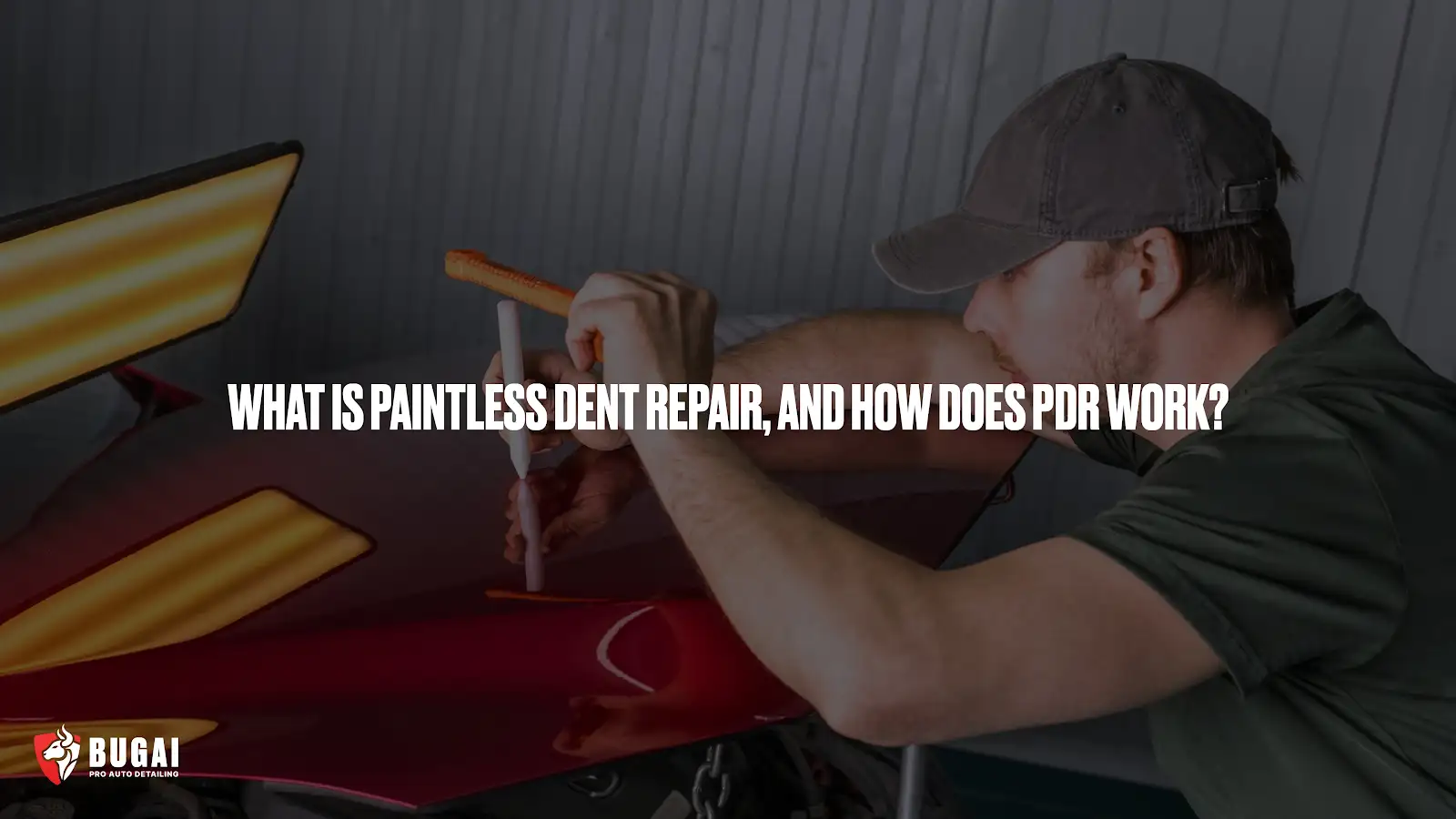
Paintless dent repair, or PDR, is a method of reshaping a dented metal panel without conventional body filler and repainting when the existing finish remains suitable.


