

.svg)
What Is Paint Correction,
and What Does It Do?
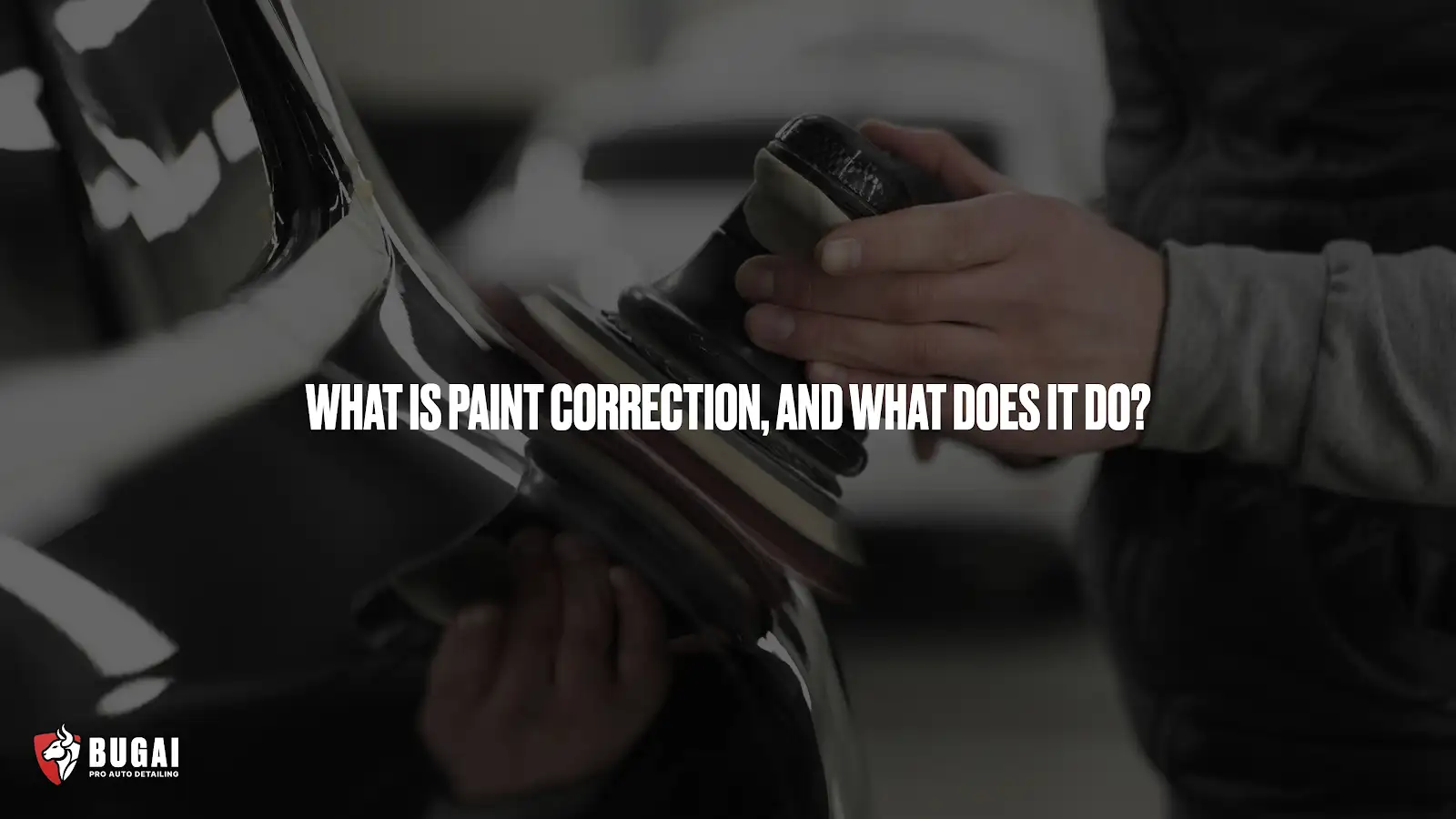
Paint correction is controlled abrasive machine polishing that removes or reduces defects by leveling a microscopic amount of the paint's outer layer.
Paint correction is often described with dramatic before-and-after language, yet the underlying process is precise and limited: a technician uses abrasives to refine the vehicle's painted surface. Done correctly, the work can restore clarity and gloss while reducing visible defects. Done too aggressively, it can consume more clear coat than the result justifies. Understanding that balance is the key to choosing the right correction level.
What is paint correction on a car?
Paint correction is controlled abrasive machine polishing that removes or reduces defects by leveling a microscopic amount of the paint's outer layer, usually the clear coat on a modern basecoat-clearcoat finish. As the damaged, uneven surface is refined, light reflects more evenly. The finish can appear deeper, clearer, and glossier, while swirls, haze, and some scratches become less visible or disappear.
The word "correction" does not mean paint is being added. It is fundamentally different from several commonly confused services:
- Touch-up paint adds color to a chip or localized area but may not make the repair level or invisible.
- Repainting replaces or rebuilds the coating system on a panel and belongs to body-shop work.
- Glaze can temporarily fill or visually mask fine marks without removing them.
- Wax or sealant adds a sacrificial protective layer but does not level scratches.
- Ceramic coating creates a durable protective layer with maintenance benefits; it does not erase defects beneath it.
- Paint-protection film adds a physical film over the surface and is intended to resist impacts and abrasion; it is not a substitute for correcting the underlying finish.
Most factory automotive finishes include primer, color coat, and clear coat. Many of the marks that disturb gloss are within that transparent outer layer. A polishing pad and abrasive compound remove a very small amount from the peaks surrounding a defect, making the surface more uniform. Because the clear coat is finite and performs important protective functions, correction should be purposeful rather than automatic.
Paint correction also differs from a quick gloss enhancement. A detailer may use a finishing polish to improve clarity without pursuing every visible mark. True correction involves inspection, a test spot, a defined improvement goal, and ongoing evaluation of paint response. The safest target is rarely "remove everything." It is achieve the best responsible improvement while preserving the coating for the future.
How does paint correction work?
Paint correction works through a sequence of preparation, testing, polishing, and inspection. The order matters. Polishing dirty or contaminated paint can trap particles under the pad, add new defects, and produce a result that looks inconsistent under proper lighting.
Step 1: Inspect and document the finish
The technician looks for swirls, oxidation, water spots, sanding marks, scratches, chips, repainting, thin edges, failing clear coat, and previous repairs. Lighting from more than one angle helps separate true defects from reflections or residue. Paint-depth readings may be used where appropriate, but a meter is one input rather than a complete safety guarantee.
Step 2: Wash and decontaminate
The vehicle receives a controlled wash. Chemical decontamination targets materials such as iron deposits or tar, while mechanical decontamination may remove remaining bonded particles. The surface should be clean and smooth before a polishing pad touches it.
Step 3: Mask sensitive areas and perform a test spot
Edges, textured trim, badges, film boundaries, and vulnerable areas may be masked or approached carefully. A small representative area is polished first. The test spot shows how the specific paint responds to a particular machine, pad, abrasive, speed, pressure, and number of passes.
Step 4: Correct and refine
If defects require more cut, a compound removes material faster. A refining polish then reduces haze left by the cutting stage and restores clarity. On lighter defects, one polishing stage may provide an acceptable balance of cut and finish. Pads are cleaned or changed as residue and removed paint accumulate.
Step 5: Inspect, clean, and protect
Panels are checked under suitable lighting from several angles. A panel wipe can remove polishing oils so the technician sees the real finish instead of temporary filling. After the result is accepted, wax, sealant, ceramic coating, or paint-protection film may be applied under a separate, clearly defined scope.
3M's published polishing procedures illustrate the professional logic: staged abrasive work, controlled tool motion, clean pads, inspection, and refinement. The brand of compound is less important than correct diagnosis and disciplined technique. A stronger abrasive is not automatically a better answer.
What defects can paint correction remove or improve?
Paint correction can remove or improve defects that remain within a safely polishable portion of the clear coat or painted surface. Whether a mark is removable cannot be decided from its name alone. Depth, location, paint history, film build, temperature, tool choice, and the owner's goals all affect the safe outcome.
| Defect | What correction may do | Important limitation |
|---|---|---|
| Fine wash swirls | Often remove or substantially reduce them | New poor washing can create new swirls later |
| Light haze or micro-marring | Refine the surface and restore clarity | Soft paint may re-mar during wiping if technique is poor |
| Mild oxidation | Remove degraded surface material and improve gloss | Severe or failing paint may require refinishing |
| Light clear-coat scratches | Reduce or remove them when depth permits | A scratch through clear coat cannot be polished away safely |
| Water-spot residue or shallow etching | Clean, level, or reduce the affected area | Deep mineral etching may remain visible |
| Light sanding marks | Refine them with an appropriate staged process | Coarse or deep sanding damage can consume too much film build |
| Bird-dropping or chemical etching | Improve shallow defects | Deep etching can remain after the safe stopping point |
| Holograms from prior polishing | Remove the directional haze with proper refinement | Requires clean pads, suitable polish, and controlled technique |
A practical way to classify defects is removable, improvable, or non-correctable by polishing. Fine swirls may be removable. A deeper random scratch may be improvable: its sharp white appearance can soften even though a line remains. A chip exposing primer or metal is non-correctable through polishing because material is missing rather than merely uneven.
Some products contain fillers or oils that make defects appear reduced before the surface is cleaned. That temporary appearance is not the same as abrasive correction. A panel wipe and inspection under direct lighting help reveal whether the defect was actually removed, merely softened, or visually masked.
Expectations should be agreed before the full vehicle is polished. On a daily driver, leaving a few deeper defects can be the correct decision because chasing them would remove disproportionate clear coat. On a show-oriented vehicle, the owner may accept more time and cost, but the same physical limits still apply. Safe improvement is the goal; perfection is not a responsible default promise.
What defects cannot be safely corrected?
Paint correction cannot safely repair defects that extend beyond the polishable coating or occur in paint that is already structurally compromised. Scratches through the clear coat, deep chips, cracks, delamination, peeling clear coat, corrosion, and areas with insufficient film build require repair rather than increasingly aggressive polishing. A machine polisher removes material; it cannot replace material that is missing or re-bond a failing coating.
The most important non-correctable conditions include:
- a scratch that has penetrated through clear coat into color, primer, or metal;
- a chip with missing paint or active corrosion;
- clear-coat failure, peeling, checking, or delamination;
- cracks caused by impact, substrate movement, or previous repair failure;
- very thin paint, especially on edges, body lines, or repeatedly polished panels;
- solvent pop, severe texture, or coating defects that require refinishing;
- damage beneath paint-protection film that cannot be accessed without film removal;
- burn-through or sanding damage already created by prior work.
The familiar "fingernail test" can be a rough warning sign: if a fingernail catches strongly, the defect may be too deep for complete removal. It is not a measurement and should not be treated as permission to polish. Paint-depth meters can add information, but readings must be interpreted by substrate and paint system. A conventional gauge may read total coating thickness rather than isolated clear-coat thickness, and composite panels require compatible equipment.
Authoritative refinishing procedures from 3M emphasize controlled abrasive sequences and inspection rather than unlimited defect chasing. That reflects the physical limit of the coating: each compounding or polishing cycle changes film build. Product directions from 3M and Meguiar's also specify suitable tools, pad condition, working areas, and technique because abrasive performance depends on the entire process, not just the liquid in the bottle.
When a defect reaches the safe stopping point, the responsible options are to accept improvement, use touch-up for a chip, consult a qualified body shop for localized refinishing, repaint the panel, or protect the area from further deterioration. A professional assessment should make that boundary clear before work begins.
What is the difference between one-step and multi-stage correction?
A one-step correction uses one primary machine-polishing stage to balance defect removal and finish quality. A multi-stage correction separates stronger cutting from finer refinement. More stages mean more labor and potentially more correction, but they do not automatically mean a better decision for every vehicle. The appropriate process depends on the finish, defects, paint response, remaining film build, and desired outcome.
| Factor | One-step correction | Multi-stage correction |
|---|---|---|
| Main goal | Improve gloss and reduce light-to-moderate defects efficiently | Address heavier defects, then restore high clarity |
| Abrasive sequence | One pad/product combination or one main polishing stage | Compound or cut stage followed by one or more refining stages |
| Suitable condition | Fine swirls, light haze, moderate defects on responsive paint | Deeper swirls, oxidation, sanding marks, or haze requiring separate refinement |
| Labor | Lower because fewer panel passes are required | Higher because panels are processed and inspected repeatedly |
| Finish risk | A compromise product may cut less or finish less perfectly | Strong cutting can leave haze that must be removed in refinement |
| Clear-coat preservation | Often the conservative choice when it meets the goal | Must be justified by the improvement and coating condition |
| Expected outcome | Noticeable enhancement, not a guaranteed defect percentage | Greater potential improvement, still limited by safe defect depth |
Modern abrasives and pads allow some one-step combinations to cut and finish surprisingly well. But paint systems behave differently. A combination that finishes clearly on harder paint may leave micro-marring on a softer finish. Conversely, a very mild polish may produce gloss without meaningfully reducing deeper swirls. That is why the test spot matters more than the package label.
A two-step process commonly uses compounding to level defects, followed by polishing to remove compound haze and restore clarity. A third stage may be justified for specialized refinement, severe oxidation, sanding-mark removal, or a demanding finish, but each added pass should have a clear purpose. "Three-step" is not a universal technical standard; providers may count washing, decontamination, or protection differently. Ask which abrasive stages are actually included.
The best proposal states the intended result, the process selected after testing, the known limitations, and the protection applied afterward. Avoid estimates that promise a fixed correction percentage without inspecting the vehicle. Percentages may communicate an approximate visual target, but they are not a direct measurement of every defect on every panel.
How do detailers decide how aggressive the correction should be?
Detailers should use the least aggressive method that achieves the agreed improvement. That principle protects clear coat, reduces unnecessary risk, and leaves more options for future maintenance. The decision is made through inspection and a test spot rather than by selecting the strongest compound at the start.
The main decision factors are:
- Defect type and depth: fine swirls need less cut than sanding marks or severe oxidation.
- Paint response: hard paint may resist correction, while soft paint may correct quickly but haze or re-mar easily.
- Panel history: repainting, previous correction, body repair, and unknown film build increase uncertainty.
- Location: edges, raised body lines, tight curves, and thin areas concentrate pressure and heat.
- Substrate and coating system: steel, aluminum, composite panels, matte finishes, and specialty coatings need different reasoning.
- Owner goal: a daily-driver enhancement and a show-oriented finish justify different time and risk profiles.
- Time and budget: these should shape the attainable goal, not encourage unsafe shortcuts.
The technician first chooses a mild pad-and-polish combination for a test area. If the result does not meet the agreed objective, aggressiveness may be increased in controlled steps. After a cutting combination achieves sufficient improvement, the area is inspected for haze or micro-marring and refined if needed. Lighting, panel temperature, pad cleanliness, machine movement, and residue removal are monitored throughout.
Paint-depth readings are valuable when used correctly, especially when panels show signs of repair or repeated polishing. They do not eliminate judgment. Total thickness can vary from factory, repaired panels may contain filler or extra coating, and some gauges cannot measure all substrates. Edges may be thinner than the flat section where the reading was taken.
A written estimate should therefore describe a proposed stage, not an unconditional promise. The final process may change after the test spot reveals how the finish behaves. If the desired improvement requires disproportionate removal, the professional answer is to stop, explain the limitation, and recommend touch-up or refinishing where appropriate.
Does paint correction permanently remove swirls?
When abrasive correction truly removes a swirl, that individual defect does not reappear on its own. The uneven clear coat that created the reflection has been leveled. However, paint correction is not permanent protection. New contact can create new swirls, and remaining defects that were filled rather than removed may become visible again as the filler washes away.
This distinction explains why a vehicle can look excellent after correction and show marring months later. Common sources of new marks include automatic brush washes, dirty wash mitts, shared self-service brushes, wiping dust from dry paint, contaminated drying towels, poor towel pressure, and polishing with dirty pads. Soft paint can mark from comparatively gentle contact, so maintenance technique matters even when premium protection is present.
To determine whether defects were removed rather than hidden, the technician can use appropriate inspection lighting and a surface-cleaning panel wipe after polishing. Oils are normal components of many polishes, but they can temporarily reduce the contrast of fine defects. Honest documentation should distinguish true correction, partial improvement, and residual marks left for safety.
Protection helps with maintenance but does not make the clear coat scratch-proof:
- wax and sealant can improve slickness and provide a sacrificial surface layer;
- ceramic coating can improve chemical resistance and ease of cleaning;
- paint-protection film adds a thicker physical barrier and may absorb some impacts and abrasion;
- none of these products makes poor washing harmless.
Preserving the result means using a controlled wash process: rinse loose contamination, use clean media, separate wheel tools, avoid unnecessary pressure, dry with clean towels or suitable air, and remove bird droppings or chemical contamination promptly. Follow the aftercare instructions for the applied coating or film.
It is more accurate to say paint correction resets the finish, while maintenance determines how long that appearance lasts. A well-maintained vehicle may retain clarity for a long time. A corrected car returned immediately to aggressive contact washing can acquire fresh swirls very quickly.
Should ceramic coating or PPF be applied after correction?
Ceramic coating or paint-protection film may be applied after correction, but neither is automatically required. The right protection depends on the owner's goals, vehicle use, budget, condition, and tolerance for maintenance. Correction improves the surface; protection helps preserve it. The two scopes should be priced and described separately.
| Protection option | Main purpose | Relationship to correction | Important limitation |
|---|---|---|---|
| Wax | Short-term sacrificial protection and appearance | Often applied after light polishing | Requires more frequent renewal |
| Synthetic sealant | Durable paint protection compared with many traditional waxes | Benefits from clean, properly prepared paint | Does not resist rock impacts like film |
| Ceramic coating | Chemical resistance, water behavior, easier maintenance, gloss | Surface usually needs thorough preparation; correction may be recommended if defects would be sealed beneath it | Not scratch-proof and does not repair paint |
| Paint-protection film | Physical barrier against chips, abrasion, and road impacts | Best installed over clean, acceptable paint; correction may improve what remains visible beneath transparent film | Film has edges, care requirements, and finite service life |
A nearly new vehicle may need only decontamination and a light refining step before protection. A used vehicle with obvious swirls may benefit from one-step or multi-stage correction so defects are not visually locked beneath a long-term coating or transparent film. Yet correction should not be performed only because a protection package is being sold. If the owner accepts the existing finish and additional polishing offers little value, preservation may take priority.
Coating preparation typically requires a clean, oil-free surface and controlled application conditions. PPF installation has its own preparation, pattern, edge, and curing requirements. Film can be applied to selected high-impact areas or to much of the exterior, while a coating is commonly used across broader painted surfaces. Some owners combine them, using film for physical impact zones and coating for easier cleaning, but compatibility and aftercare should be confirmed with the installer.
BGI offers both ceramic paint protection and paint-protection film. An inspection can separate three decisions that are often bundled together: how much correction is responsible, which protection fits the use case, and what preparation each product requires.
What are the risks of DIY paint correction?
DIY paint correction can improve a finish, but the risks include removing too much clear coat, burning through edges, creating haze or holograms, overheating panels, and adding scratches with contaminated tools. The danger is not only a powerful machine. Incorrect combinations, excessive passes, dirty pads, poor lighting, and a failure to recognize paint damage can produce an uneven result or a repair bill.
Common DIY failure points include:
- beginning with an aggressive compound before testing a mild approach;
- holding a polisher on one spot or applying excess pressure;
- working carelessly over sharp edges and raised body lines;
- using an unsuitable pad or abrasive for soft or hard paint;
- allowing spent product and removed paint to load the pad;
- polishing a surface that was not fully washed and decontaminated;
- wiping residue with dirty or inappropriate towels;
- mistaking deep damage, clear-coat failure, or repainting for correctable swirls;
- judging the finish only under diffuse garage light;
- applying coating before polishing oils and residue are properly removed.
Entry-level dual-action polishers are generally more forgiving than rotary machines, but "safer" does not mean risk-free. A pad can still build heat, strike trim, or cut more strongly on an edge. Small backing plates and compact machines improve access but can concentrate work on a small area. Rotary machines can correct efficiently in skilled hands, yet poor control can leave holograms or cause rapid damage.
If you choose to work on your own vehicle, read the paint-care guidance in the owner's manual and the exact directions for the machine, pad, and abrasive. Practice on a low-risk panel or test piece, use clean pads, inspect frequently, keep cables and tools away from paint, and stop when the defect's depth is uncertain. Do not polish matte finishes unless the manufacturer provides an approved process; abrasion can create a permanent glossy patch.
Professional help is particularly sensible for valuable vehicles, unfamiliar repainted panels, severe oxidation, deep scratches, thin edges, specialty finishes, or preparation for long-term coating or PPF. The cost of assessment is small compared with repainting a panel after burn-through.
What is the bottom line on automotive paint correction?
The bottom line is that paint correction can restore clarity, increase gloss, and remove or reduce many defects, but it does so by removing a controlled amount of coating. It cannot replace missing paint, repair failing clear coat, or make a vehicle immune to future swirls. The best correction is the least aggressive process that reaches the owner's realistic goal.
Use this decision framework:
| Observed condition | Likely starting point | Professional priority |
|---|---|---|
| Fine swirls and light haze | Test a one-step polish | Balance cut, finish, and clear-coat preservation |
| Moderate swirls or oxidation | Test one-step, then evaluate a two-step process | Confirm improvement and refine any compounding haze |
| Heavy defects or sanding marks | Multi-stage assessment | Measure, test, and stop before disproportionate film removal |
| Deep scratch, chip, peeling, or delamination | Repair or refinishing consultation | Do not chase missing or failing paint with abrasives |
| Acceptable finish before coating or PPF | Decontamination and minimal refinement as needed | Avoid unnecessary correction merely to enlarge the package |
Industry process guidance from 3M supports a staged, inspected approach: prepare the surface, use the appropriate abrasive step, keep the pad and work area controlled, refine the finish, and inspect the actual result. The practical expert recommendation is consistent with that logic: start mild, prove the process on a test spot, preserve edges and film build, and stop when further removal is not justified.
The estimate should identify the proposed number of polishing stages, surface preparation, test-spot process, known exclusions, expected level of improvement, protection, cure or pickup timing, and aftercare. Any promised percentage should be treated as a visual target rather than a guarantee that every defect will be removed.
BGI can assess the paint in appropriate lighting and discuss whether the vehicle needs enhancement, one-step correction, multi-stage work, or a repair referral. That inspection can also determine whether ceramic protection or PPF should follow the correction. The result is a scope built around the actual vehicle rather than a generic promise.

Security film can delay entry and increase the effort or noise required, but it cannot guarantee that a determined intruder will never create an opening.
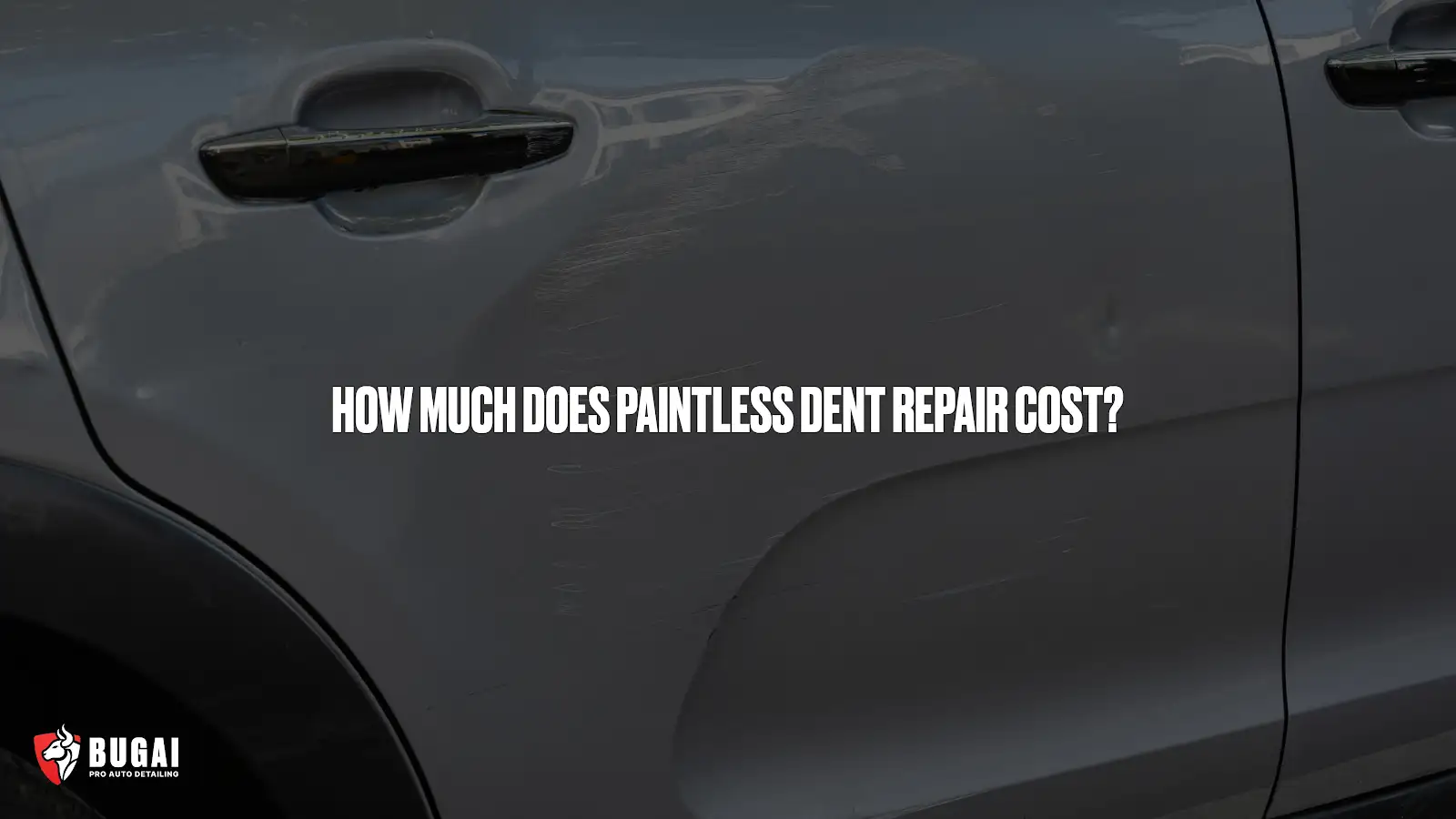
A written inspection-based estimate is more reliable than a single advertised average.
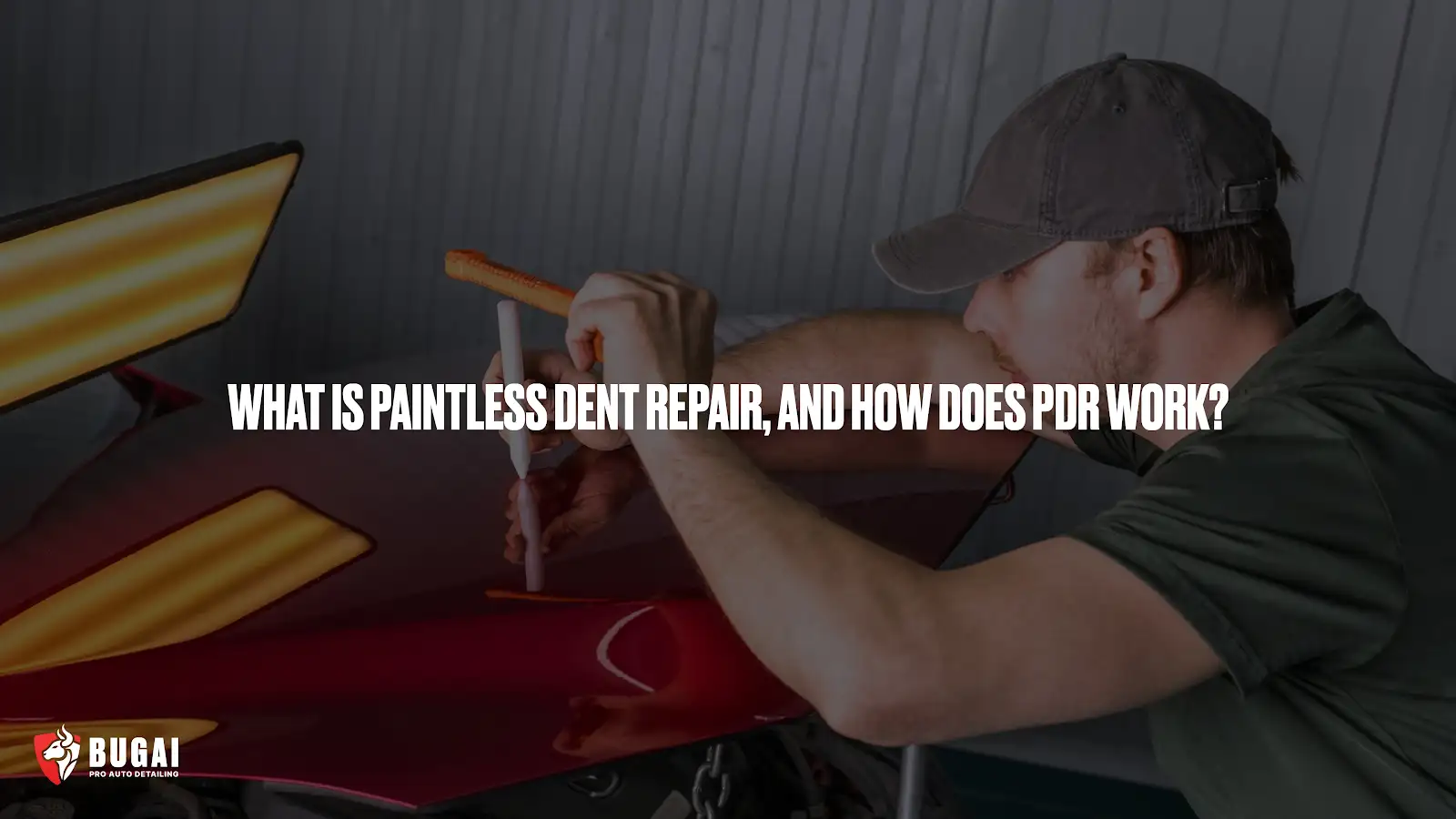
Paintless dent repair, or PDR, is a method of reshaping a dented metal panel without conventional body filler and repainting when the existing finish remains suitable.


